
Election Pulse 2026
POLITICS
Vishal Thakur
5/4/20262 min read
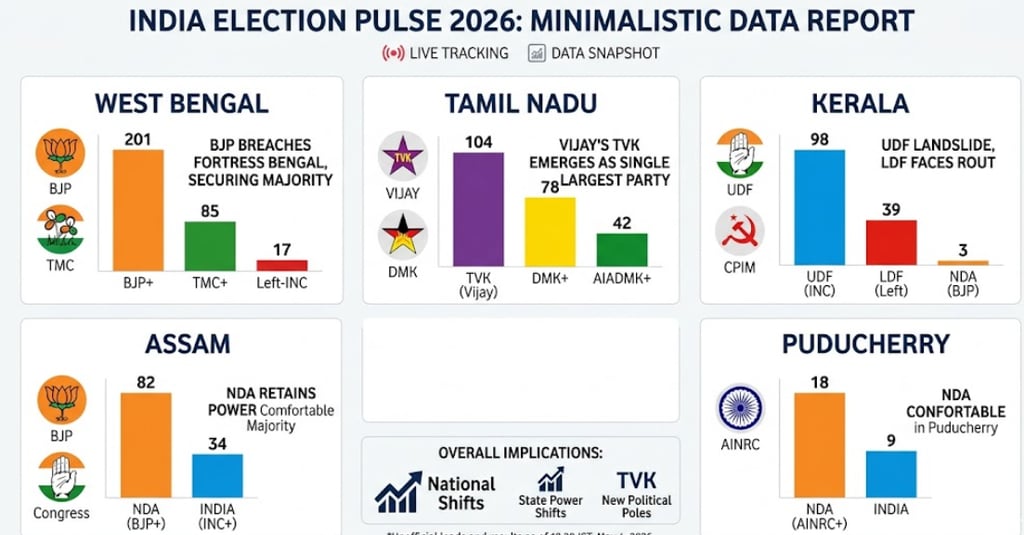

The May 4, 2026, counting day has delivered a series of political earthquakes across India, redrawing the electoral map in five key regions. From the historic saffron surge in the East to the cinematic disruption in the South, the "Election Pulse 2026" report captures a nation in the midst of a profound political transition.
West Bengal: The Fall of the Fortress
For the first time in history, the Bharatiya Janata Party (BJP) has breached the "Fortress Bengal." Surpassing the majority mark of 148, the saffron party is currently trending toward a staggering 201 seats. The mandate signals the end of the Trinamool Congress’s (TMC) 15-year reign. While Chief Minister Mamata Banerjee maintains a narrow lead in Bhabanipur, her party has faced a sweeping rout in rural districts and industrial belts. Prime Minister Narendra Modi characterized the victory as a "spectacular mandate" that will be remembered forever.
Tamil Nadu: The Vijay Blockbuster
In a debut that has stunned veteran pollsters, superstar Vijay’s Tamilaga Vettri Kazhagam (TVK) has emerged as the single largest party. Leading in 107 seats, Vijay has effectively shattered the five-decade-old DMK-AIADMK duopoly. The scale of the "Vijay effect" is most visible in the stunning defeat of Chief Minister MK Stalin in his stronghold of Kolathur. Positioned on a platform of youth-centric welfare and secular social justice, TVK has captured nearly 34% of the vote share, marking the arrival of a new, dominant pole in Dravidian politics.
Kerala: The Return of Tradition
Kerala has upheld its long-standing tradition of "changing the guard," rejecting the CPI(M)-led LDF’s bid for a historic third term. The Congress-led UDF has swept the state, leading in 102 out of 140 seats. The mandate is an indictment of the incumbent government, with over a dozen ministers, including Chief Minister Pinarayi Vijayan, trailing in early rounds. Simultaneously, the BJP achieved its best-ever performance in the state, securing three seats—Nemom, Kazhakoottam, and Chathannoor—signaling a softening of the state’s historical resistance to the party.
Assam: The Sarma Hat-Trick
Assam stands as the outlier of stability, with Chief Minister Himanta Biswa Sarma leading the NDA to a third consecutive victory. The alliance has crossed the 100-seat mark, largely due to Sarma’s ability to convert incumbency into a pro-governance wave. A major casualty of this stability was the Congress, whose state president Gaurav Gogoi lost his seat in Jorhat to the BJP’s Hitendra Nath Goswami by a margin of over 23,000 votes.
The Broader Verdict
The 2026 results represent a "turning point" for the national landscape. While the BJP consolidates its expansion into the East and makes incremental gains in the South, the rise of TVK in Tamil Nadu and the UDF's resurgence in Kerala highlight a fragmented opposition that is increasingly revolving around strong regional identities and a resurgent Congress in specific pockets.
As counting concludes, these states offer a preview of the road to the 2029 Lok Sabha elections, showcasing a voter base that is increasingly unafraid to dismantle established dynasties in favor of new alternatives.
Connect
contact@blowpost.com
© 2025. All rights reserved.
BlowPost is an independent geopolitical and market intelligence publication. We cater to traders, bankers, logistics professionals, and anyone who wants to understand the structural forces beneath global events — energy markets, capital flows, and trade corridors. No ideology. No institutional interest. Just the structure.