
Global Markets Rally as Iran Reopens Strait of Hormuz Amid Fragile Lebanon Ceasefire
MARKETS
Vishal Thakur
4/17/20262 min read
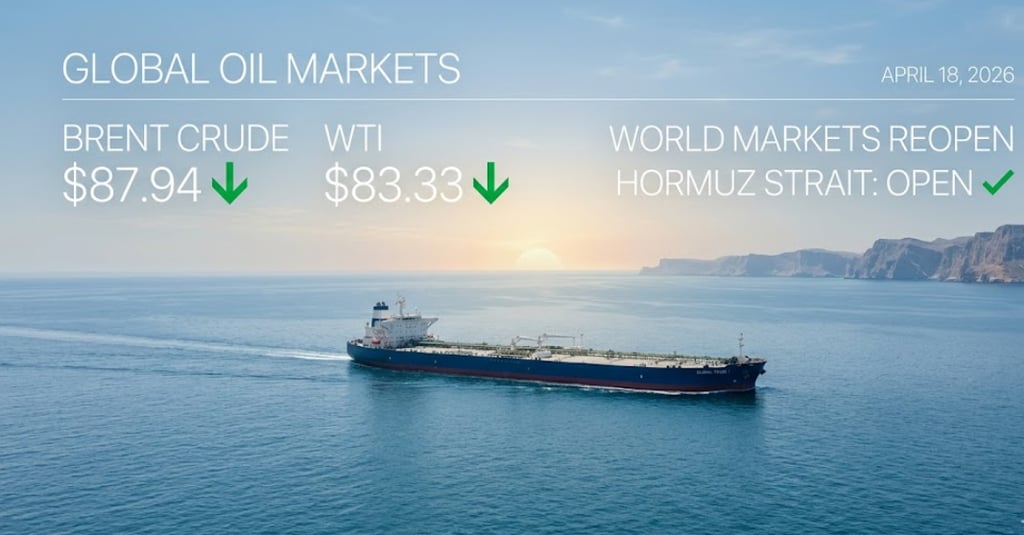
DUBAI/WASHINGTON — In a major breakthrough for global energy security, Iranian Foreign Minister Abbas Araghchi announced on Friday that the Strait of Hormuz is now "completely open" to all commercial maritime traffic. The declaration, which comes 49 days into the devastating "US-Israel War on Iran," sent shockwaves through global markets, causing Brent crude prices to plummet by over 11%.
The reopening is explicitly linked to a 10-day ceasefire between Israel and Hezbollah in Lebanon, which began early Friday morning.
"Ready for Business"
Foreign Minister Araghchi confirmed the move in a post on X (formerly Twitter), stating, "In line with the ceasefire in Lebanon, the passage for all commercial vessels through the Strait of Hormuz is declared completely open for the remaining period of the ceasefire."
The Ports and Maritime Organisation of Iran has established a "coordinated route" for all transiting vessels. However, Iranian military officials warned that the opening applies strictly to non-military ships. Any military transit remains prohibited and subject to IRGC Navy authorization—a point of friction as U.S. destroyers reportedly began mine-clearing operations in the waterway earlier this week.
Trump Maintains Pressure
While President Donald Trump initially celebrated the news on social media, hailing it as a "GREAT AND BRILLIANT DAY FOR THE WORLD," he quickly clarified that the U.S. campaign of "maximum pressure" is far from over.
"The Strait of Hormuz is completely open and ready for business," Trump wrote on Truth Social. "But the naval blockade will remain in full force and effect as it pertains to Iran, only, until such time as our transaction with Iran is 100% complete."
The U.S. naval blockade, initiated on April 13 after the failure of peace talks in Islamabad, has already forced at least 19 vessels to turn back to Iranian ports. Analysts suggest Trump is using the blockade as a final lever to secure a comprehensive deal that includes the permanent suspension of Iran’s nuclear program.
Oil Prices Plunge, Wall Street Surges
The economic relief was instantaneous. After weeks of trading near the $120 mark, Brent crude futures tumbled to $87.94 a barrel, down 11.5% on the day. U.S. West Texas Intermediate (WTI) followed suit, dropping to $83.33.
On Wall Street, the Dow Jones Industrial Average surged more than 700 points, while airline and cruise ship stocks—industries crippled by surging fuel costs during the seven-week conflict—saw gains of nearly 10%.
A Fragile Peace
Despite the optimism, the situation on the ground remains precarious.
The "Nuclear Dust" Dispute: President Trump claimed Iran has agreed to hand over its enriched uranium—which he termed "nuclear dust"—to the U.S. Tehran’s state-run Mizan news agency flatly denied this, stating "no negotiation regarding the transfer" has ever occurred.
Ceasefire Violations: While the Lebanon truce is largely holding, U.N. peacekeepers reported instances of Israeli artillery shelling in southern Lebanon Friday afternoon, which Israel defended as self-defense measures permitted under the agreement.
As the world watches the 10-day countdown of the Lebanon ceasefire, the primary question remains: can this temporary window of open trade be converted into a permanent peace, or is the global economy merely enjoying a brief respite before a second wave of conflict?
For more live updates on the US-Iran Conflict and Global Energy Markets, stay tuned to our Live Blog.
Connect
contact@blowpost.com
© 2025. All rights reserved.
BlowPost is an independent geopolitical and market intelligence publication. We cater to traders, bankers, logistics professionals, and anyone who wants to understand the structural forces beneath global events — energy markets, capital flows, and trade corridors. No ideology. No institutional interest. Just the structure.