
Iranian Speaker Ghalibaf Declares ‘New World Order’ Led by Global South, Citing ‘70-Day Resistance’
Vishal Thakur
5/17/20263 min read
TEHRAN — Iranian Parliament Speaker Mohammad Bagher Ghalibaf declared on Sunday that the international arena has arrived at the "cusp of a new order," asserting that the traditional dominance of Western powers is rapidly crumbling and that the "future belongs to the Global South."
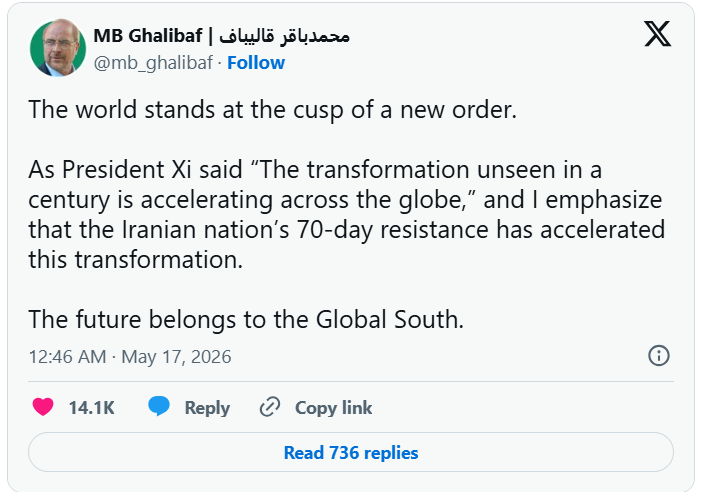
Ghalibaf’s high-profile remarks, published on the social media platform X on Saturday night, directly invoked Chinese President Xi Jinping’s signature geopolitical thesis of "transformations unseen in a century." Crucially, Ghalibaf asserted that Iran’s recent "70-day resistance" against intense US and Israeli military and economic campaigns has acted as the primary catalyst, dramatically shortening the timeline for this global paradigm shift.
"The world stands at the cusp of a new order," Ghalibaf posted. "As President Xi said, 'The transformation unseen in a century is accelerating across the globe,' and I emphasize that the Iranian nation's 70-day resistance has accelerated this transformation. The future belongs to the Global South."
The timing of Ghalibaf’s strategic intervention is highly calculated. It comes on the immediate heels of a high-stakes bilateral summit in Beijing, where President Xi hosted US President Donald Trump. As Washington and Beijing engaged in intense negotiations over trade tariffs, economic concessions, and the critical status of Taiwan, Tehran watched the proceedings with acute attention.
During his meeting with Trump, President Xi remarked, "Currently, a transformation not seen in a century is accelerating across the globe and the international situation is fluid and turbulent." Pointedly referring to the recent military escalation in West Asia, Xi raised the concept of the "Thucydides trap"—the historical structural tension that occurs when a rising power challenges a ruling hegemon—and urged the US to find a cooperative, stable paradigm rather than resorting to confrontation.
By echoing Xi's exact terminology, Ghalibaf has sought to align Tehran’s defiance directly with Beijing’s broader systemic challenge to American hegemony, positioning Iran's localized armed conflict as a core element of a global revisionist shift.
The "70-day resistance" referenced by Ghalibaf refers to the devastating military conflict that erupted on February 28, 2026, when the United States and Israel launched a massive joint military offensive against Iran, codenamed Operation Epic Fury.
The opening salvo of the campaign saw hundreds of airstrikes target Iranian military infrastructure and government installations, resulting in the assassination of Supreme Leader Ali Khamenei and dozens of top-tier military and civil officials.
Iran retaliated forcefully, launching hundreds of ballistic missiles and thousands of suicide drones targeting Israeli-occupied territories, US military bases across the Middle East, and maritime corridors. Iran’s blockade and closure of the strategic Strait of Hormuz—the world's most vital oil chokepoint—triggered immediate shocks to the global energy supply, sending oil prices soaring and causing widespread economic disruptions worldwide.
A fragile, Pakistan-mediated temporary ceasefire went into effect on April 8, pausing major hostilities. However, the subsequent "Islamabad Talks" stalled due to incompatible demands, leading to a lingering "dual blockade" in the Persian Gulf where the US Navy seeks to contain Iranian trade while Iran restricts passage through the Gulf.
Ghalibaf’s framing of this bloody, high-stakes 70-day window is designed to project a narrative of strategic success. From Tehran’s perspective, surviving a decapitating military campaign by two of the world's most advanced workforces has demonstrated that Western military hegemony is no longer absolute.
Iranian state-aligned media, including the state broadcaster Press TV, immediately amplified Ghalibaf's declarations. State media outlets have framed Iran's survival as an ideological blueprint for developing nations across Latin America, Africa, and Asia.
"Developing nations increasingly recognize that the era of Western hegemony, which is marked by unilateral sanctions, military adventurism, and economic domination, is drawing to a close," Press TV reported in its coverage of Ghalibaf’s statement. The network argued that the resilience of the "Axis of Resistance" provides a concrete alternative to a unipolar international system governed by Washington.
Diplomatic analysts note that while Iran has suffered catastrophic internal damage and high-level leadership losses during the conflict, the political elite in Tehran is aggressively attempting to leverage the stalemate to secure its position in the emerging diplomatic architecture. By placing itself at the vanguard of the "Global South," Tehran hopes to dilute its diplomatic isolation and foster deeper economic and security ties with non-aligned, emerging economies that are eager to bypass Western financial and political networks.
As the ceasefire remains precarious and negotiations hang in the balance, Ghalibaf's declarations underscore a fundamental reality: the conflict in the Middle East is no longer viewed in Tehran as a localized struggle for survival, but rather as the opening chapter of a fundamentally rewritten global order.
Connect
contact@blowpost.com
© 2025. All rights reserved.
BlowPost is an independent geopolitical and market intelligence publication. We cater to traders, bankers, logistics professionals, and anyone who wants to understand the structural forces beneath global events — energy markets, capital flows, and trade corridors. No ideology. No institutional interest. Just the structure.