
Migrant Exodus Due to the LPG Crisis?
ECONOMY
Vishal Thakur
4/7/20263 min read
Fact-Check: Is There Really a Migrant Exodus Due to the LPG Crisis?
In recent weeks, rumors have been swirling across social media and certain news outlets suggesting a repeat of past migrations—this time triggered not by a pandemic, but by a fuel crisis. While the Indian government has officially stepped in to refute reports that migrant workers are fleeing cities in large numbers, a more nuanced picture is emerging from the industrial floor. Here is a breakdown of the current situation, balancing official data with ground-level economic observations and independent field research.
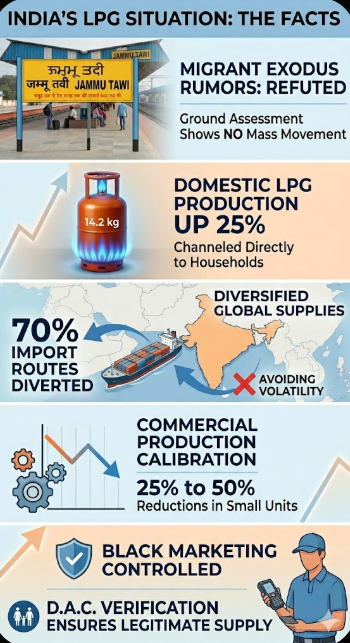
The root of the anxiety lies in the ongoing conflict in West Asia, which has caused ripples in global energy supply chains. Because India relies significantly on imports for its Liquefied Petroleum Gas (LPG) needs, concerns about shortages began to trigger panic among some vulnerable populations, particularly migrant workers who often rely on small-scale gas connections. To address the rumors of a mass exodus, top government sources conducted a week-long, ground-level assessment at major railway stations across the country. The findings were conclusive from a mobility standpoint, as tracked passenger data at major hubs showed no unusual spike that would indicate a mass return of workers. A senior official confirmed that after a week of monitoring, there were no signs of migrants returning to their native places in large numbers. Consequently, a detailed fact-check report has been submitted to the Prime Minister’s Office to stabilize public sentiment and ensure the administration remains informed of the actual status.
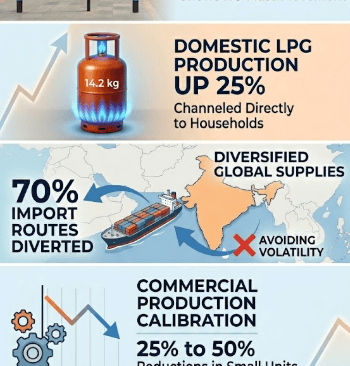
Addressing the supply-side concerns, Sujata Sharma, Joint Secretary (Marketing & Oil Refinery) in the Ministry of Petroleum and Natural Gas, has provided specific data regarding India's energy resilience. Official reports indicate that domestic LPG production has grown by 25 percent, and crucially, this entire increase is being directly channeled into the domestic sector to prioritize household needs. Furthermore, the logistics of energy security have been recalibrated; currently, 70 percent of oil imports are being channeled through different routes than the Strait of Hormuz. This diversification of supply routes is intended to mitigate the risks posed by regional volatility in West Asia.
While the railway stations might not be crowded with departing workers, the industrial sector is clearly feeling the pinch. Personal ground reports and independent research from commercial hubs suggest a complex reality where commercial enterprises and small-scale manufacturing units have reportedly cut production by half or even a quarter. Despite these significant cuts, the broader economic cycle remains operational. The infrastructure is not collapsing; rather, it is recalibrating to the current energy availability. Workers appear to be choosing a strategy of waiting out the storm rather than a total shutdown or return to their villages, reflecting a cautious approach to energy uncertainty rather than a complete halt of activity.
One of the most critical findings from recent field research is the successful control of black marketing. Historically, fuel shortages have led to a surge in illegal trade and price gouging, but current ground reports indicate that inventory control and monitoring of cylinder distribution have effectively squeezed out middleman exploitation. Strict vigilance and the implementation of Delivery Authentication Codes are showing tangible results on the ground, keeping supplies in the legitimate channel despite the global supply pressure.
The Ministry of Petroleum and Natural Gas has been proactive in ensuring that the domestic supply lines remain robust. Approximately 6.75 lakh 5-kg Free Trade LPG cylinders have been sold nationwide since March 23, specifically catering to the needs of migrant populations who may not have permanent addresses. High digital efficiency has also played a role, with online LPG bookings reaching 97% and 90% of deliveries now using a Delivery Authentication Code, which correlates directly with the field reports of controlled black marketing.
The situation is a tale of two realities. While the data suggests that India’s domestic LPG distribution system is holding firm and preventing a mass exodus, the commercial sector is clearly under strain. The economic engine is still humming, but with production cuts of up to 50% in some areas, the focus remains on stabilization. Crucially, the control of black marketing, the surge in domestic-focused production, and the strategic shift in import routes have prevented the situation from escalating into a social crisis. For now, the workforce remains in place, weathering the slowdown in anticipation of a stabilized global supply chain.
Source: ANI News Reports, Government Briefings (Joint Secretary Sujata Sharma, Ministry of Petroleum and Natural Gas), Independent Field Research, and Industrial Assessments, April 7, 2026
Connect
contact@blowpost.com
© 2025. All rights reserved.
BlowPost is an independent geopolitical and market intelligence publication. We cater to traders, bankers, logistics professionals, and anyone who wants to understand the structural forces beneath global events — energy markets, capital flows, and trade corridors. No ideology. No institutional interest. Just the structure.