
The Digital Mirror
Technology’s Quiet Transformation of the Human Soul.
TECH
Heena
4/12/20263 min read
Technology was once understood as a collection of tools designed to solve specific physical problems, yet it has evolved into the very environment in which we live, breathe, and define ourselves. For this Sunday edition of BlowPost, we move beyond the immediate noise of geopolitical conflict to examine the profound ways in which our innovations are rewriting the human story. We are currently witnessing the birth of a new era where the boundary between the biological and the digital is becoming increasingly porous. This shift is most evident in the recent advancements by companies like Neuralink, which have moved from theoretical discussions to the first human trials of brain-computer interfaces. While these devices are marketed as medical miracles for the impaired, their ultimate destination is the augmentation of the healthy. The prospect of a perfect-recall memory or direct-to-brain information streams forces us to confront a terrifying question: if the human capacity to forget is erased, what happens to our ability to forgive? A life without the natural decay of memory is a life without the grace of a fresh start, potentially trapping the individual in a permanent, vivid loop of past mistakes and grievances.
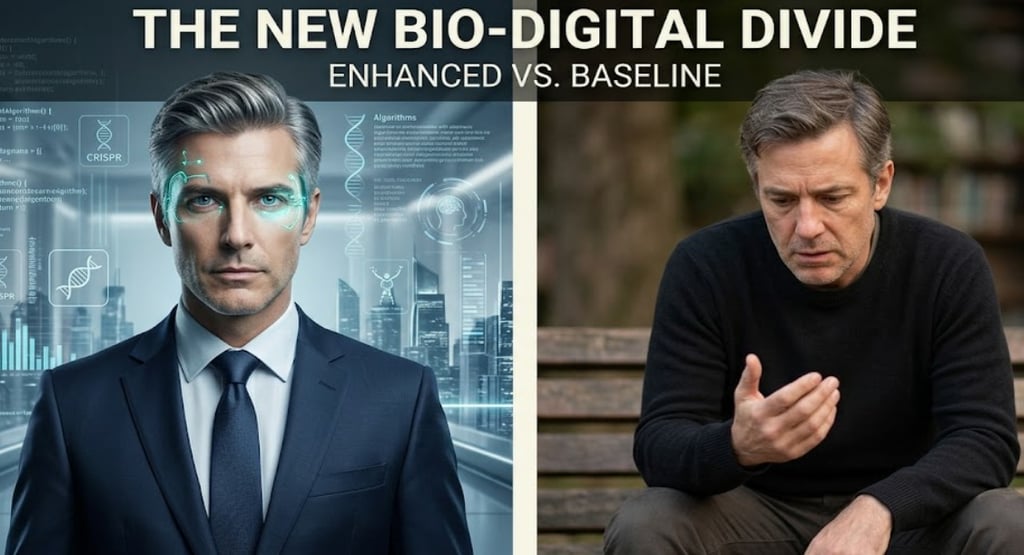
This transformation extends beyond our biology and into our search for meaning. As traditional institutions struggle to remain relevant in a hyper-accelerated world, a quiet shift is occurring in how we seek philosophical guidance. Data now suggests that individuals are increasingly turning to generative AI models not just for tasks, but for spiritual and ethical direction. This "Silicon Sermon" represents a fundamental departure from human tradition. When our moral frameworks are guided by predictive text algorithms rather than shared human history or divinity, we risk outsourcing the most essential part of our humanity to a black box. This trend is further complicated by the emerging bio-digital divide. The rise of CRISPR-based genetic editing and neural implants is creating a class system defined not by bank accounts, but by biological capability.
It is important to acknowledge that the world has never been a place of perfect equality; we already live in a landscape of profound economic and social disparity. However, these new technologies threaten to move us from a world of different starting lines to a world of different species. While a wealthy individual today might buy better healthcare, their basic human limitations remain the same as anyone else's. The impending shift represents a break in the social contract of equality because it transforms "having more" into "being more." If one group of people is literally smarter, faster, and longer-lived than another through biological enhancement, the idea of universal human rights—built on the premise that we are all fundamentally the same kind of being—becomes a biological impossibility. The friction between the "enhanced" and the "baseline" human is no longer science fiction; it is a burgeoning reality that could fundamentally rupture the shared human experience.
At BlowPost, we look past the hype of innovation to see the invisible structures driving these changes. One such structure is the convenience trap, where every technological leap is sold as a way to make life easier, while its hidden purpose is the total extraction of behavioral data. The more we rely on these systems, the more we surrender our agency to the algorithms that manage our comfort. Parallel to this is the acceleration fallacy, the dangerous belief that social and biological systems can keep pace with Moore’s Law. This mismatch creates the modern anxiety that defines our era, as our linear brains struggle to process exponential change. Finally, we must recognize the efficiency obsession. Modern technology views human friction—emotions, errors, and slow deliberation—as bugs to be optimized away. However, in the pursuit of a perfectly efficient world, we risk erasing the very qualities like serendipity and compassion that make the human experience worth having.
Editor’s Note: The "Invisible Structures" discussed in this essay represent BlowPost's editorial analysis and hypothesis regarding the strategic drivers of technological adoption. It is intended to offer a deeper perspective on the forces at play and should be read as a philosophical and analytical interpretation of current trends.
Connect
contact@blowpost.com
© 2025. All rights reserved.
BlowPost is an independent geopolitical and market intelligence publication. We cater to traders, bankers, logistics professionals, and anyone who wants to understand the structural forces beneath global events — energy markets, capital flows, and trade corridors. No ideology. No institutional interest. Just the structure.