
The $35 Trillion Loophole: Meet the New Masters of Global Trade
Vishal Thakur
4/14/20262 min read
If you follow the news, you’ve heard about the "Great Decoupling"—the massive economic divorce between the United States and China. You’ve heard about tariffs, trade wars, and the fragmentation of the global order.
But while the headlines focus on the friction, a quiet revolution is happening in the background.
According to the latest UNCTAD Global Trade Updates, global trade hit a staggering $35 trillion in 2025. How? Because even as superpowers pull apart, they are staying connected through a new class of logistical powerhouses: The Connector Economies.
What is a "Connector Economy"?
Think of them as the logistical middlemen of the 21st century. As direct trade between rival blocs becomes politically toxic or expensive, these nations step in to bridge the gap.
A "Connector Economy" is a neutral hub that maintains deep, thriving trade relationships with both the West and the China-aligned bloc. They aren't just shipping ports; they are assembly points, mineral hubs, and "resilience pads" that keep the global economy from stalling.
The Big Four: Who’s Winning the Rerouting Race?
While everyone is watching the trade deficit in Washington or Beijing, these four nations are quietly becoming the new centers of gravity:
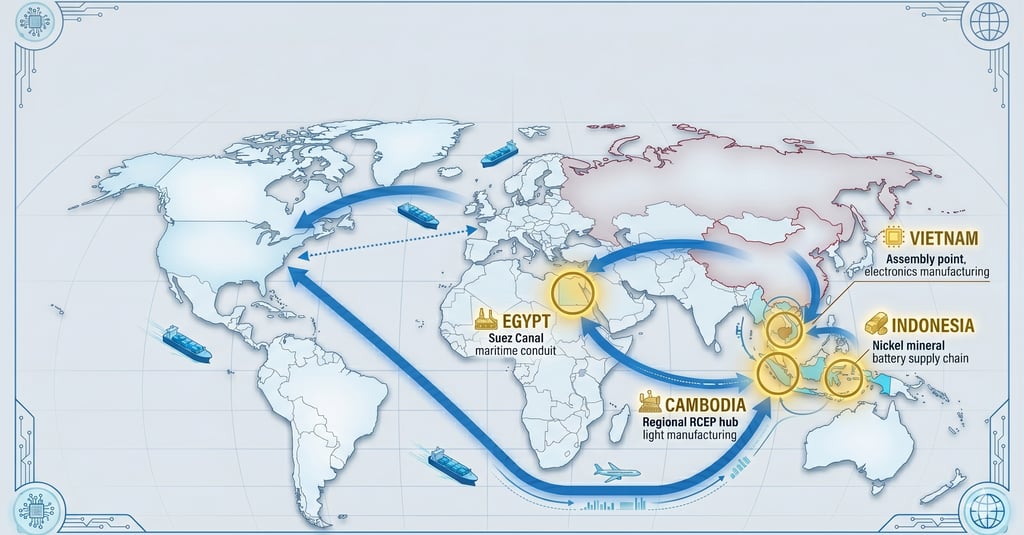
Vietnam (The Manufacturing Proxy): When a company wants to avoid U.S. tariffs on Chinese-made electronics, they move assembly to Vietnam. Components still come from China, but the finished product ships out as "Made in Vietnam."
Indonesia (The Mineral Bridge): As the world shifts to EVs, Indonesia’s control over nickel has made it an indispensable partner for battery tech for both Western automakers and Chinese tech giants.
Cambodia (The Regional Pivot): Leveraging the RCEP agreement, Cambodia is rapidly transforming into a light manufacturing and assembly powerhouse for the Southeast Asian region.
Egypt (The Maritime Chokepoint): Controlling the Suez Canal makes Egypt the ultimate stabilizer. Even amid regional volatility, it remains the primary conduit for trade moving between Europe and Asia.
Why Are They Overlooked?
We often miss these winners because their growth is "invisible" in traditional bilateral data.
South-South Trade is Exploding: Trade between developing nations grew by 9% in 2025, outperforming the global average.
The Inflation Buffer: By allowing goods to flow through "friend-shored" routes, these countries prevent costs from skyrocketing for consumers in the West.
Strategic Neutrality: These nations have mastered the art of not picking sides. They take investment from China's Belt and Road Initiative and Western infrastructure funds simultaneously.
Being a "connector" isn't without danger. These nations face the risk of "transshipment crackdowns" if superpowers decide they are merely helping to evade tariffs. They also face massive internal pressure on their infrastructure—ports and power grids are being pushed to their limits by the sheer volume of rerouted trade.
The global economy isn't shrinking; it’s reorganizing. As the world moves toward a "multipolar" model, the most successful businesses and investors won't be those who bet on one superpower over another. They will be the ones who understand and leverage the Connector Economies.
Disclaimer: The information provided in this article is for informational and educational purposes only and does not constitute financial, investment, or legal advice. Global trade dynamics are subject to rapid change due to geopolitical shifts. Readers should perform their own due diligence before making any business or investment decisions based on the content of this post.
Connect
contact@blowpost.com
© 2025. All rights reserved.
BlowPost is an independent geopolitical and market intelligence publication. We cater to traders, bankers, logistics professionals, and anyone who wants to understand the structural forces beneath global events — energy markets, capital flows, and trade corridors. No ideology. No institutional interest. Just the structure.