
The Fortress and the Family: What India’s ₹7.8 Trillion Defense Budget Means for You
ECONOMY
Vishal Thakur
4/14/20262 min read
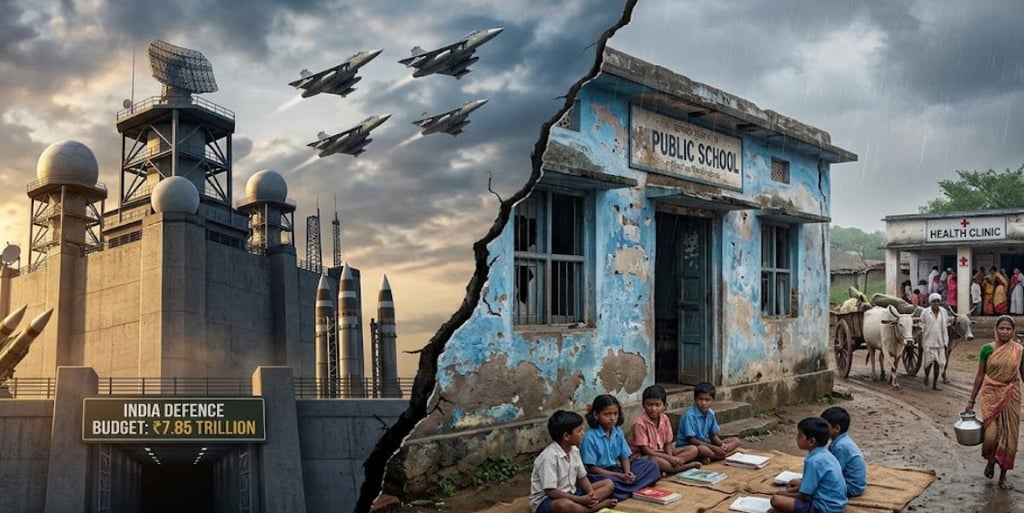
India became the world's fourth-largest military spender in 2026. The question the headline does not answer is where the money comes from and what it does not fund
The headlines are buzzing: India is now the world’s fourth-largest military spender. Finance Minister Nirmala Sitharaman recently announced a staggering ₹7.85 trillion ($94 billion) allocation for defense in the 2026-27 Union Budget. On paper, it looks like a bold statement of national strength. It’s a 15% jump from last year, sparked by the tensions of Operation Sindoor and the need to modernize our skies with Rafales and Sukhois.
But behind the gleaming jets and the "4th largest" title lies a much tougher question for the average Indian citizen: Where is this money coming from, and what is it not buying?
The "Security First" Society
To understand this budget, imagine a family living in a neighborhood where tensions are rising. The father decides to install high-tech CCTV cameras, hire a 24/7 guard, and buy a reinforced steel door.
The family feels safer. But to pay for that door, they have to cancel the children’s extra tutoring, postpone a much-needed hospital check-up, and buy cheaper, less nutritious groceries.
This is the society we are becoming. We are building a "Fortress Nation." We are exceptionally well-protected from external threats, but the "furniture" inside the house—our schools, our healthcare, and our environment—is starting to show wear and tear.
The IMF (International Monetary Fund) recently pointed out a sobering fact: two-thirds of military booms like this are funded by debt. We aren't paying for these missiles with "extra" money; we are taking out massive loans.
The Layman’s View: We are essentially swiping a credit card to buy fighter jets. Today, we feel powerful. Tomorrow, our children will have to pay the interest on that card through higher taxes or fewer government services.
The Indian Rupee is currently at a record low. When we buy 114 Rafale fighters from France or drones from the US, we have to pay in foreign currency.
The Layman’s View: Because our Rupee is weak, every jet costs us more today than it would have two years ago. This "extra" cost drains our national savings, leaving less money for the government to stabilize the prices of petrol, diesel, and cooking gas.
The Stagnation: While defense spending jumped 15%, spending on social infrastructure—like public health and green energy—is barely keeping up with inflation. We are choosing "Hardware" (weapons) over "Humanware" (education and health).
What Kind of Nation Are We Building?
There is a clear strategic logic to being prepared. No one wants a weak India. But a nation’s true strength isn't just measured by the caliber of its guns; it’s measured by the quality of life of its people.
We are at a crossroads:
We are becoming a nation that defines greatness by military rank.
We are risking becoming a nation where basic prosperity is a secondary thought.
India is building very strong walls. But as the current account deficit widens and foreign reserves are spent defending a falling Rupee, we must ask: Is the house inside the walls getting the care it needs? When we celebrate the 15% hike in defense, we must also remember the "hidden 15%"—the potential progress in our hospitals and classrooms that we’ve put on hold to keep the fortress standing.
Note on Data and Analysis: The budgetary figures and events (such as Operation Sindoor and the 2026-27 Union Budget allocations) cited in this article are based on current reported data and fiscal trends. The interpretations regarding societal impact and "Security First" transitions represent a personal analytical perspective on the long-term implications of these choices.
Connect
contact@blowpost.com
© 2025. All rights reserved.
BlowPost is an independent geopolitical and market intelligence publication. We cater to traders, bankers, logistics professionals, and anyone who wants to understand the structural forces beneath global events — energy markets, capital flows, and trade corridors. No ideology. No institutional interest. Just the structure.