
The Great Mechanical Leap: Humanoid Robots Outpace Humanity at the 2026 Beijing Half Marathon
TECH
Vishal Thakur
4/19/20263 min read
The Core Findings
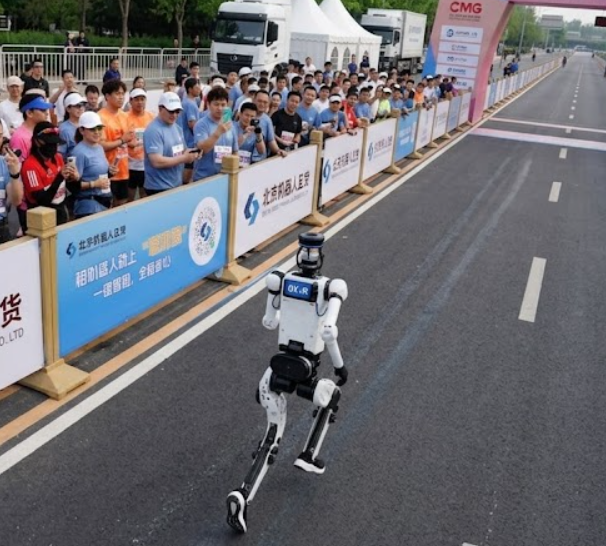
The Record: The Chinese robot "Flash," developed by Honor(Honor Device Co.Ltd), completed the Beijing Half Marathon in 50 minutes and 26 seconds, shattering the human world record of 57:20.
Rapid Evolution: Winning times dropped from 2 hours and 40 minutes in 2025 to just over 50 minutes in 2026.
Technological Edge: Success was driven by liquid cooling systems and biomimetic leg designs that allowed for a sustained running speed of 25 km/h.
Autonomous Milestone: 40% of the robots navigated the course autonomously, marking a shift from remote-controlled prototypes to intelligent machines.
Economic Impact: The event served as a "utility validation" for investors, leading to over 1 million yuan in immediate industrial orders for the winners.
The morning of April 19, 2026, marked a definitive shift in the history of robotics as the sound of rhythmic mechanical pounding echoed through Beijing’s E-Town District. During the second annual Beijing Humanoid Robot Half Marathon, the boundary between biological and mechanical capability was not just crossed—it was obliterated. The winning humanoid, a model named "Flash" (or Lightning) developed by the Huawei spin-off Honor, crossed the finish line in a staggering 50 minutes and 26 seconds. To put this in perspective, the robot finished nearly seven minutes faster than the fastest human to ever run the distance, Uganda’s Jacob Kiplimo. While a remotely piloted version of the same machine actually finished even faster at 48 minutes and 19 seconds, the official title was awarded to the autonomous version, proving that these machines are now capable of making high-speed tactical decisions without a human tether.
This leap in performance is nothing short of exponential. Only a year ago, the inaugural race was won by the "Tiangong Ultra" with a time of 2 hours and 40 minutes—a pace that many amateur human joggers could maintain. The transition from "slow shuffle" to "world-class sprint" in just twelve months is a testament to the aggressive engineering focused on three specific bottlenecks: heat, stride, and sight. Honor’s engineers solved the persistent issue of motor overheating by integrating liquid cooling technology directly into the joints, a feat of miniaturization adapted from high-end smartphone hardware. This allowed the robot to maintain a punishing average speed of 25 km/h. Furthermore, the "Flash" was designed with biomimetic legs specifically tuned to mimic the 95 cm stride of elite human marathoners, allowing for a gait that looked less like a machine and more like a professional athlete.
The diversity of the field also signaled a maturing ecosystem, with over 300 robots from 100 different teams participating. While domestic giants like Unitree and the Beijing Humanoid Robot Innovation Center dominated the podium, the presence of five international teams highlighted the global stakes of the competition. However, the race also served as a sobering reminder of the hurdles that remain. The winning robot provided a viral and somewhat humbling moment when it suffered a perception failure just meters from the finish line, crashing into a safety railing and requiring manual assistance to cross the timing mat. Other competitors suffered structural failures, literally breaking apart under the mechanical stress of the high-speed run. These incidents underscore that while robots have mastered the raw physics of speed, the "edge case" intelligence required to navigate a complex, unpredictable world is still being refined.
Beyond the spectacle of the race, there is a clear economic and strategic undercurrent driving these advancements. The marathon was a high-profile demonstration of China’s 2026-2030 Five-Year Plan, which designates humanoid robotics as a critical "frontier science." By turning a marathon into a testing ground, the Beijing government is effectively bridging the gap between laboratory curiosities and commercial assets. The million-yuan industrial orders awarded to the winners suggest that these robots are already being eyed for roles in logistics, emergency response, and manufacturing. As the 2026 Beijing Half Marathon concludes, the "uncanny valley" of robotic locomotion seems to have closed for good; the challenge now is no longer whether a robot can outrun a human, but how safely and intelligently it can walk among us.
Connect
contact@blowpost.com
© 2025. All rights reserved.
BlowPost is an independent geopolitical and market intelligence publication. We cater to traders, bankers, logistics professionals, and anyone who wants to understand the structural forces beneath global events — energy markets, capital flows, and trade corridors. No ideology. No institutional interest. Just the structure.