
THE REBOOT: When voters stop choosing sides and start replacing systems
POLITICS
Vishal Thakur
4/13/20266 min read


Péter Magyar is a Hungarian politician and lawyer who is the president of the Tisza Party
On the night of April 12, 2026, Viktor Orbán called Péter Magyar to concede. He had been prime minister of Hungary for 16 consecutive years. His party, Fidesz, had held a supermajority in parliament since 2010. It controlled the courts, the state media, the electoral boundaries, and much of the country's private media landscape. None of it was enough. Magyar's Tisza party won 138 of 199 parliamentary seats on 53.6% of the vote, a two-thirds supermajority, in an election where nearly 79% of eligible voters turned out — the highest participation in Hungary's post-Communist history. Fidesz was left with 55 seats, down from 135. The loss of 80 seats in a single night by a government that had systematically rebuilt the political architecture in its own favour is not a normal electoral defeat. It is a system failure.
Nepal Prime Minister Balen Shah
Six weeks earlier, on March 27, 2026, Balendra Shah was sworn in as Nepal's prime minister at 12:34 in the afternoon, a time selected for astrological auspiciousness. He is 36 years old. A rapper and structural engineer from Madhes, Shah led the Rastriya Swatantra Party, a political organisation that did not exist four years ago. His party won 182 of 275 parliamentary seats in the March 5 general election, a result without precedent in Nepal's modern history. The parties that had governed the country in rotating coalition for two decades — the Nepali Congress, the CPN-UML, the Maoist factions — were effectively erased. The man he defeated in his own constituency, former prime minister K.P. Sharma Oli, lost by nearly 50,000 votes.
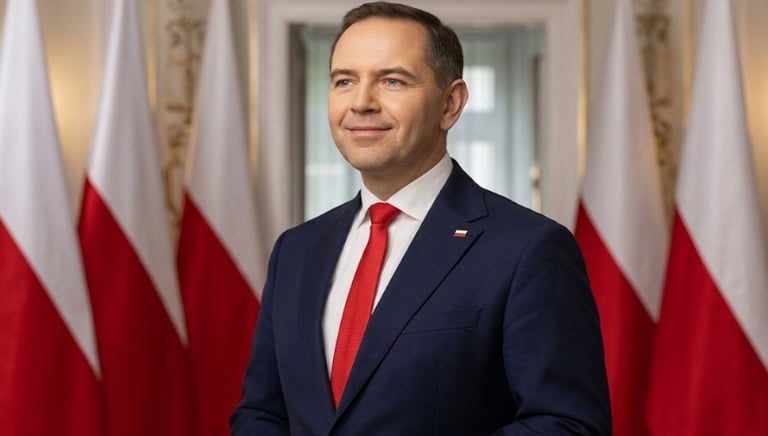
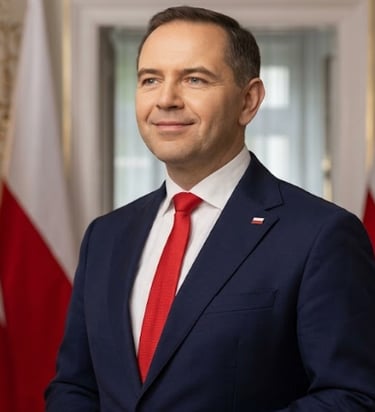
karol Nawrocki, President of the Republic of Poland
Three years before that, in October 2023, Poland's Law and Justice party lost power after eight years in government. In that election, turnout among voters aged 18 to 29 reached 68.8%, compared to 46.4% in the previous election. Support for Law and Justice within that age group collapsed from 26.3% to 14.9%. The opposition took power. Poland was described at the time as a democratic correction, a return to European norms. Barack Obama called Hungary's result last night an echo of Poland 2023 — "a victory for democracy, not just in Europe but around the world."
That framing is understandable. It is also incomplete.
Because if you look only at who won and who lost, you miss the only number that actually matters across all three elections. In each case, what collapsed was not a political position. What collapsed was a government that had been in power long enough to become indistinguishable from the state itself. In Hungary, Orbán rewrote electoral boundaries, replaced constitutional judges, and handed broadcast licences to loyalists. In Nepal, the political elite had cycled through eight cabinets across three men in ten years while youth unemployment compounded and skilled workers left the country by the thousands every month. In Poland, a government that had systematically weakened the judiciary and captured state media had simply been in place for too long with too little to show.
The voters in all three countries did not agree on ideology. They agreed on one thing: the current arrangement was not working, and it needed to be replaced.
This is the pattern. It is not a left-wing wave or a right-wing correction. It is something more mechanical than that, and governments across the world are either not reading it or choosing not to.
Nepal is where the technology dimension of this pattern becomes impossible to ignore. The trigger for the uprising that brought down Oli's government in September 2025 was a government order banning 26 social media platforms — YouTube, Facebook, WhatsApp — for failing to register under new digital regulations. Within days, what began as a protest about an internet ban became a national reckoning about everything else: corruption, nepotism, youth unemployment, the permanent gap between what governments promised and what they delivered. At least 76 people died. The parliament was dissolved. Elections were called. Balen Shah's government, which replaced the one that ordered the ban, has announced a Digital First governance model — a fully paperless state, unified digital service platforms, national digital identity infrastructure. The government that tried to control the information layer was replaced by one that intends to rebuild it as public infrastructure.
In Hungary, the information layer was fought over from a different direction. Russian intelligence services were reportedly involved in the campaign, with Russia's SVR proposing a staged assassination attempt on Orbán to boost his electoral odds, while a Russian bot network circulated disinformation on social media presenting Ukraine and its president as threats to Hungary's safety. The operation failed. Magyar won by the largest margin in Hungarian democratic history. The electorate, saturated by years of state media manipulation and now encountering external disinformation on top of it, did not respond by withdrawing from politics. It responded by voting at 79%.
This is a direct inversion of the assumption that information control equals political control. That assumption — which is not unique to Hungary or Nepal or any single country — rests on the idea that if you control what people read, hear, and see, you control how they vote. The evidence from the last three years suggests the mechanism has limits that are not always visible until they break all at once.
Poland in 2023 added a complication that is worth sitting with. After Law and Justice was defeated, the liberal coalition that took power was greeted across Europe as a return to democratic norms. By 2025, it had lost the presidential election to a PiS-backed candidate, partly because voters felt the new government had not delivered on its core promises. The pendulum did not swing back to the right because voters changed their values. It swung back because voters applied the same logic they had applied in 2023: the people in power were not delivering, and therefore they needed to be replaced.
This is the clean version of the pattern: electorates are increasingly operating as feedback systems rather than as ideological camps. When a system is producing poor outputs — corruption, unemployment, institutional decay, information manipulation — and the feedback loop is open, meaning elections are competitive and votes are counted, the system gets rebooted. The ideology of the replacement government is secondary. What matters is that the replacement is new enough to be distinguishable from what it replaced.
The implications of this extend well beyond Hungary and Nepal. Any government with a long tenure, concentrated institutional control, and a growing gap between its official narrative and the lived economic reality of its citizens is sitting on the same structural risk. The specific trigger is unpredictable — in Nepal it was a social media ban, in Hungary it was sixteen years of accumulated resentment amplified by a corruption scandal involving a presidential pardon in a child abuse case that broke in early 2024. The trigger is almost always something that looks small from the outside.
What is not small is the underlying condition that makes the trigger effective. That condition is a population, typically young, economically frustrated, digitally connected, and sufficiently organised to convert frustration into a coordinated electoral event. Nepal's Gen Z movement registered nearly a million new voters. Hungary's turnout hit a post-Communist record. Poland's youth turnout in 2023 was the highest recorded. In each case, the mobilisation was not organised by established opposition parties. It was organised through networks that the governments in question did not control and, in some cases, had actively tried to suppress.
The technology companies whose platforms carried this organising did not choose sides. They provided infrastructure. The governments that tried to restrict that infrastructure paid for it politically. The ones that tried to weaponise it with disinformation found that the weapon had a ceiling.
None of this means incumbency is fatal or that established governments cannot survive. What it means is that the terms of political survival have changed. Longevity in power is no longer a source of stability. In the current environment, longevity without visible delivery is a liability, and the longer it compounds, the more total the eventual correction tends to be. Orbán's Fidesz did not lose narrowly. It lost 80 seats. Nepal's old parties were not reduced to opposition. They were functionally eliminated. These are not close calls. They are reboots.
The question worth tracking — for Hungary, for Nepal, for any government watching these results — is whether the new administrations understand what actually brought them to power. Magyar and Shah both won on mandates for institutional reform and anti-corruption. Both face the same structural test: deliver enough, fast enough, to stay distinguishable from what they replaced before the feedback loop opens again.
History on this is not encouraging. Poland's liberal coalition failed that test in under two years. The voters noticed.


Connect
contact@blowpost.com
© 2025. All rights reserved.
BlowPost is an independent geopolitical and market intelligence publication. We cater to traders, bankers, logistics professionals, and anyone who wants to understand the structural forces beneath global events — energy markets, capital flows, and trade corridors. No ideology. No institutional interest. Just the structure.