
The Women's Reservation Bill: A Real Promise or a Political Game?
POLITICS
Vishal Thakur
4/19/20263 min read
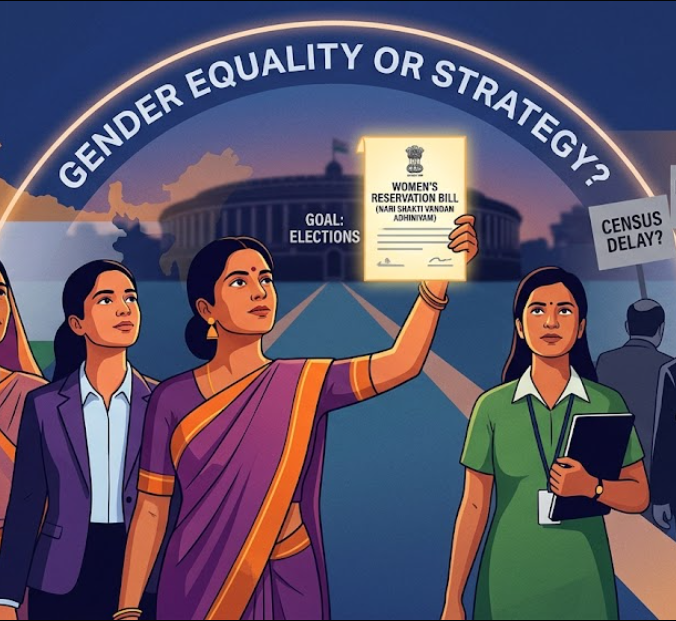
The passage of the Women's Reservation Bill in September 2023 was a moment that many thought would change Indian politics forever. By promising to reserve one-third of the seats in the Lok Sabha and State Assemblies for women, the government took a step that had been stuck in Parliament for nearly three decades. However, as the dust settled, the focus shifted from the victory itself to the fine print of the law. A specific clause in the amendment says that this reservation can only happen after a new census is conducted and the boundaries of voting areas are redrawn. This single rule has turned a move for social justice into a fierce political debate leading up to the 2029 elections.
The government argues that its approach is based on constitutional correctness and long-term stability. Their main point is that implementing such a massive change without redrawing boundaries would lead to legal chaos. They believe a formal commission must decide which seats should be reserved to ensure the process is fair and transparent. By passing the law now, they claim they have built a permanent legal foundation that ensures women will eventually get their due, no matter which party is in power later. Even when they tried to speed up the process in April 2026 by suggesting the use of older census data, they framed it as an attempt to meet the 2029 goal, positioning themselves as the champions of women's growth.
However, the political tension reached a breaking point on April 17, 2026, when the Constitution (131st Amendment) Bill was officially defeated in the Lok Sabha. Despite a long debate that lasted past midnight, the government could not secure the two-thirds majority required for a constitutional change. The final count saw 298 "Ayes" and 230 "Noes." While the majority of those present voted for the bill, it fell short of the 352 votes needed to pass. The opposition, including the Congress, DMK, and TMC, celebrated the defeat by thumping their desks, arguing that the bill was a "Trojan Horse" for a controversial redrawing of seats that would hurt Southern states.
A defining moment in this fallout occurred when Prime Minister Narendra Modi addressed the nation following the bill's defeat. He used his platform to sharpen the divide, speaking directly to the "mothers and daughters of the country" rather than just the politicians in the room. He stated that the "dreams of nari-shakti have been crushed mercilessly" and warned that women would never forgive or spare the opposition for this betrayal. This rhetoric acted as a double-edged sword; while it was a critique of legislative hurdles, its real intent was to signal to women voters outside that the government was their only true ally. By framing the opposition’s technical and regional concerns as a "foeticide" of women’s dreams, the Prime Minister effectively turned a legislative defeat into an emotional campaign message for 2029.
On the other side, opposition parties see a different story. They view the bill as a clever political trap. Their primary concern is that the government is using women’s reservation as a way to push through a massive redrawing of seats that could favor the North over the South. Southern states have been more successful in controlling their population growth, and they fear that a new seat count based on current numbers would reduce their political influence while giving more power to the BJP's traditional strongholds. Furthermore, many regional parties argue that the bill is incomplete because it does not include a specific quota for women from backward classes and minority communities, which they believe leaves the most vulnerable women behind.
When looking at whether this was a sincere move or a tactical play, there is evidence for both sides. The timing is hard to ignore. Bringing the bill up just before major elections and then pushing for a fast-track version in 2026 suggests the government wants to keep the "women's vote" as a central theme of their campaign. By linking the reservation to the redrawing of seats, they created a situation where the opposition felt forced to protest. This allowed the government to build a narrative—reinforced by the Prime Minister's own sharp words—that their rivals were the ones standing in the way of progress.
Yet, it is also true that the BJP succeeded where many others failed for twenty-seven years by getting the original principle into the Constitution in 2023. The truth likely falls somewhere in the middle. The government probably does want to be the one to empower women, but they have chosen a method that also serves as a powerful political weapon. In the end, this battle has set the stage for the 2029 elections. The government can now point to the "No" votes as proof that the opposition is "anti-women," while the opposition tries to explain that they are actually protecting the balance of power between different states. It remains to be seen whether the promise of 2029 is a genuine destination or simply a target used to win the next round of political points.
Connect
contact@blowpost.com
© 2025. All rights reserved.
BlowPost is an independent geopolitical and market intelligence publication. We cater to traders, bankers, logistics professionals, and anyone who wants to understand the structural forces beneath global events — energy markets, capital flows, and trade corridors. No ideology. No institutional interest. Just the structure.