
Why De-Escalation Calls Don't Work Anymore
The United Nations keeps asking the world to stop. The world keeps saying no. This is not an accident.
POLITICS
Vishal Thakur
3/20/20265 min read
Why De-Escalation Calls Don’t Work Anymore
The United Nations keeps asking the world to stop. The world keeps saying no. This is not an accident.
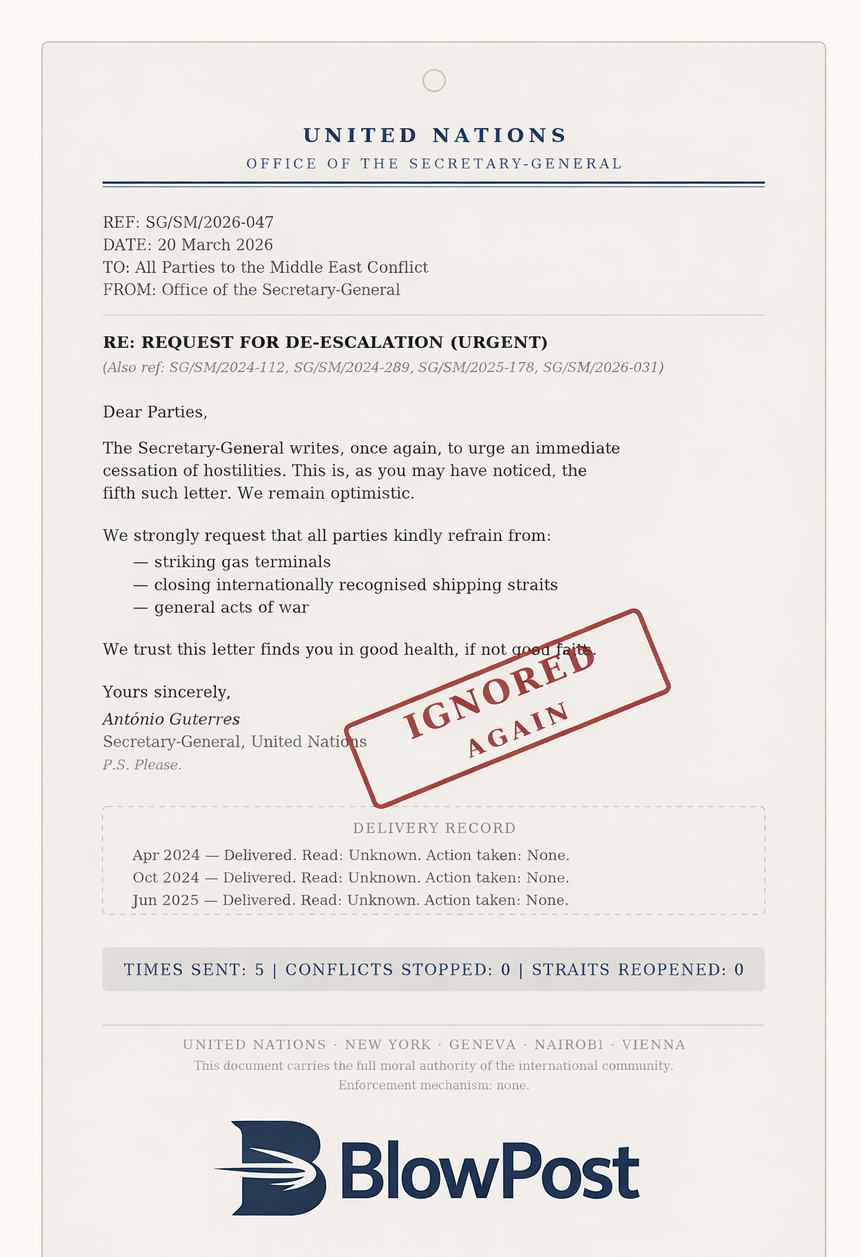
On March 20, 2026, UN Secretary-General António Guterres stepped to the podium and called for de-escalation in the Middle East. Gas terminals were burning across the Gulf. Oil had crossed $114 a barrel. The Strait of Hormuz — through which a fifth of the world's oil normally moves — was largely closed.
Nobody stopped.
This was not the first time. It was not even close to the first time. And understanding why requires going back further than last week — back to a room in San Francisco in 1945, where the architecture of the modern world was decided by five countries that had just won a war.
The original compromise
The United Nations Security Council was born in 1945 with one fundamental design flaw baked in from day one. The veto power was offered to the five permanent members — the US, UK, Russia, China, and France — because offering them the ability to protect themselves from Security Council resolutions was the only way to get them to join the UN at all. NPR
The logic was pragmatic: a peace-keeping body without the world's most powerful nations was useless. So the architects of the post-war order made a deal. The great powers would join. In exchange, no resolution could bind them without their consent.
It worked — for a while. During the Cold War, the US and Soviet Union paralysed the Council with competing vetoes, but the underlying logic held: the institution existed as a pressure valve, a place where conflict could be managed short of direct great-power confrontation.
That logic assumed one thing above all: that the permanent members would not themselves become direct parties to the conflicts the Council was supposed to resolve.
Since the UN's establishment in 1945, the veto has been used over 300 times, primarily by the US, Russia, and China — most often invoked due to the strategic interests of these nations rather than broader international consensus. NPR
The assumption held — until it didn't.
The machinery breaks down
When Israel launched military operations in Gaza in October 2023, the Security Council became the central stage for global diplomacy. And the machinery immediately seized up.
The United States vetoed a UN Security Council draft resolution demanding an immediate and unconditional ceasefire in Gaza — despite the resolution securing 14 votes in favour from the Council's 15 members. CNBC One country. One vote. Fourteen others overruled.
The US has a long history of using its Security Council veto to support Israel. The General Assembly — which includes all 193 member countries — can pass resolutions, but they are not legally binding. Only the Security Council can pass binding resolutions, and only when no permanent member objects. CNBC
This created a structural paradox that would define the next two years: the body with the power to act legally could not act, and the body that represented the world's consensus could only issue statements.
Guterres could call for ceasefire. Guterres could convene emergency sessions. Guterres could say, as he did in June 2025, "We are not drifting towards crisis — we are racing towards it."
None of it was enforceable. All of it was ignored.
The escalation ladder
The pattern that followed was consistent enough to be a law.
April 2024: Iran launched over 200 drones and missiles at Israel. Guterres called for maximum restraint. The Security Council met. No resolution passed. Israel struck Iran five days later.
October 2024: Iran fired a second missile barrage. Israel struck back. Guterres warned of a dangerous cycle of retaliation and urged all parties to cease military actions. The cycle continued.
June 2025: Israel launched a surprise attack on Iran's military and nuclear facilities — what would later be called the Twelve-Day War. The US struck three Iranian nuclear sites. Guterres convened an emergency Security Council session. The strikes continued anyway.
February 2026: The US and Israel struck Iran again. Guterres called for an immediate cessation of hostilities. Iran retaliated — not against Israel this time, but across the Gulf. Qatar, UAE, Saudi Arabia, Kuwait. The Strait of Hormuz closed.
Five de-escalation calls in under two years. Each one followed by a larger strike than the one before it.
This is not a coincidence. It is the logical output of a system where the party with blocking power at the Security Council is the same party conducting airstrikes.
The referee problem
The Security Council's powers include the ability to tell UN members to sanction entities or individuals and to take military action against an aggressor. But these powers require the concurrence of all five permanent members — meaning any one of them can unilaterally block the Council from acting. CNBC
When the US became a direct military participant in the Iran conflict in 2026, the institution's last pretence of neutrality collapsed. You cannot simultaneously hold veto power over the world's peace-keeping mechanism and conduct airstrikes in the same theatre. The roles are structurally incompatible.
Pakistan's representative at the Security Council put it plainly during one of the Gaza ceasefire vote failures: preventing the Council from fulfilling its mandate "risks being seen as enabling the continuation of that suffering." NPR
What he was describing was not diplomatic frustration. It was a structural indictment. The institution was not failing because of bad faith or weak leadership. It was failing because it was operating exactly as designed — and the design assumed a world that no longer exists.
What the UN can and cannot do
It is important to be precise here, because the criticism of the UN is often imprecise.
The United Nations is not useless. Its humanitarian agencies — the WFP, UNHCR, UNICEF — operate in conflict zones at enormous personal risk to their staff. The General Assembly provides a forum where smaller nations can speak, build coalitions, and apply moral pressure. The International Court of Justice can render judgments, even if enforcement is limited.
What the UN cannot do — structurally, legally, mechanically — is stop a war that one of its permanent Security Council members is either fighting or protecting through its veto.
Critics argue that the veto allows powerful nations to act with impunity, obstruct international justice, and undermine the Security Council's credibility. Concerns are particularly prominent in the context of international responses to genocide, war crimes, and humanitarian crises. NPR
This criticism is correct. It is also insufficient. Because identifying the problem and fixing it are two entirely different things. Reforming the veto requires an amendment to the UN Charter — which itself requires the approval of all five permanent members. Each of whom holds a veto.
The institution cannot reform itself. The countries with the power to change the rules are the same countries who benefit from keeping them unchanged.
The fog
When Guterres issued his statement on March 20, 2026 — calling on the US and Israel to end the war, and separately calling on Iran to stop attacking its neighbours and reopen the Strait — he was doing the only thing available to him. Issuing a statement. Applying moral pressure. Hoping that somewhere, someone with actual power was listening.
No one was.
This is not a failure of António Guterres. It is a failure of institutional design — a design that made perfect sense in 1945, when the goal was to prevent another world war between great powers, and makes almost no sense in 2026, when a great power is conducting airstrikes and simultaneously blocking the body that is supposed to stop them.
The fog in international affairs is rarely confusion. It is usually the gap between what institutions say and what powerful actors do. The UN says stop. The missiles keep flying. The gap between those two facts is not a mystery. It is the system working exactly as it was built to work.
Which raises the only question that matters: if the institution cannot reform itself, and the countries that control it will not change the rules, what comes next?
That is not a rhetorical question. It is the question that will define the next decade of global order — or the absence of it.
BlowPost is a global market and geopolitical intelligence publication. We Clear The Fog.
Connect
contact@blowpost.com
© 2025. All rights reserved.
BlowPost is an independent geopolitical and market intelligence publication. We cater to traders, bankers, logistics professionals, and anyone who wants to understand the structural forces beneath global events — energy markets, capital flows, and trade corridors. No ideology. No institutional interest. Just the structure.